
Can You Bring Perfume on a Plane? TSA Rules for Decants and Bottles
Can you bring perfume on a plane? You can, and most travelers do it without a second thought. The trouble starts when a favorite 100 ml bottle meets a carry-on-only trip, or when a cologne leaks across a folded shirt somewhere over the Rockies. The rules themselves are short. Knowing how they apply to a real bottle, a real bag and a real security line is what saves you from handing over a fragrance you paid good money for.
Quick answer: Yes. In a US carry-on, perfume must be in containers of 3.4 oz (100 ml) or less that fit in your one quart-size liquids bag, and larger bottles go in checked luggage. Decants from 5 ml to 20 ml sit far below that limit, which makes them the simplest way to fly with fragrance.
This guide walks through the screening rules, the separate safety limits for checked bags, the duty-free exception for connecting flights, and the small packing habits that keep a bottle sealed from gate to hotel room. It finishes with a checklist you can run through the night before you fly.
Can you bring perfume on a plane under the TSA 3-1-1 rule?
Yes. Perfume counts as a liquid at the checkpoint, so it falls under the same rule as shampoo, toothpaste and contact lens solution. The TSA Liquids, Aerosols and Gels Rule is usually shortened to 3-1-1, and each number stands for one part of the requirement.
- 3 — each container holds 3.4 ounces (100 milliliters) or less.
- 1 — every one of those containers fits inside a single quart-size bag.
- 1 — one such bag per passenger.
The quart bag is the part people forget. A fragrance in a legal-size bottle still has to share that bag with everything else that pours, squeezes or sprays. If the bag will not close, something has to move to a checked suitcase or stay home.
TSA’s own listing for perfume adds one more line worth remembering: the final decision on whether an item clears the checkpoint rests with the TSA officer. A bottle that technically fits the rule can still be pulled aside if it cannot be screened clearly. Packing well is about making that decision easy for the person at the belt.
Why it is the container, not the liquid, that counts
The limit applies to the size of the bottle, not to how much fragrance is left inside it. That point surprises a lot of travelers, and it is the reason the next section exists.
Can you bring perfume on a plane in a full-size bottle?
Only if the bottle itself is 3.4 oz (100 ml) or smaller. Many designer and niche fragrances are sold in 100 ml bottles, which sit exactly on the line. Anything labeled larger, such as a 125 ml or 200 ml flacon, belongs in checked baggage. TSA’s guidance is direct on this: pack items in containers larger than 3.4 ounces or 100 milliliters in your checked bag.
A half-empty large bottle does not get a pass. An officer cannot measure the fill level of an opaque or decorated bottle at the belt, and the rule is written around the capacity printed on the container. A 200 ml bottle with an inch of liquid left is still a 200 ml bottle.
A 100 ml bottle is allowed in a carry-on, but it is a poor travel companion. It is heavy, it takes up a big share of the quart bag, and a heavy glass flacon is the kind of thing that cracks when a roller bag tips over in an overhead bin. It is also a lot of fragrance to risk on a single trip. If you only need enough for a week, carrying the full bottle is the most expensive way to bring it.
What happens if the bottle is too big at security?
It cannot continue in your carry-on, and the options left at that point are rarely good ones when boarding is ten minutes away. That is why it pays to read the size on the bottom of the bottle while you are still packing at home.
How do you pack perfume in checked luggage?
Perfume is allowed in checked bags, and bottles too big for the cabin can travel there. Even so, there is a second set of rules in play. Fragrances contain alcohol, which makes them flammable, and the Federal Aviation Administration treats them as a personal-use exception within its hazardous materials rules. The FAA’s FAA PackSafe chart lists toiletries among the few dangerous goods that passengers may carry under set conditions.
The key number for most people is the overall cap. As TSA’s perfume listing notes, the FAA limits restricted medicinal and toiletry articles in checked bags to a total of 2 kg (70 ounces) or 2 L (68 fluid ounces) per person. That total covers perfume together with things like hair spray and other toiletries that fall under the same rule, so a large fragrance collection plus a full toiletry kit can add up faster than you think. The same TSA listing sets a ceiling for each item as well: no single container may hold more than 0.5 kg (18 ounces) or 500 ml (17 fluid ounces), which rules out an oversized display bottle even in the hold.
The FAA also points out why these items need care in the hold: vibration, temperature changes and pressure changes during a flight can cause containers to leak. A suitcase is thrown, stacked and squeezed in ways a carry-on never is. Pack accordingly.
- Center of the case — place the bottle in the middle of the suitcase, surrounded by soft clothing on every side, never against a wall or a corner.
- Cap on, sprayer covered — the cap protects the nozzle from being pressed by the weight of the bag.
- Sealed bag — put the bottle in a zip-top bag so any leak stays contained.
- Padding — a thick sock or a rolled sweater around the bottle absorbs knocks.
- Upright if possible — standing the bottle upright inside a shoe or a small box keeps liquid away from the sprayer.
Checked bags also face long stretches in hot or cold holds and on the tarmac. If you care about a fragrance’s condition, our guide to perfume storage covers why heat and light are harder on a scent than time alone.
| Question | Carry-on bag | Checked bag |
|---|---|---|
| Container size limit | 3.4 oz (100 ml) or less per container | 500 ml (17 fl oz) maximum per container |
| Bag requirement | All liquids in one quart-size bag | No quart bag needed |
| Overall quantity | Whatever fits in the quart bag | FAA total cap of 2 kg (70 oz) or 2 L (68 fl oz) of toiletry articles per person |
| Leak and breakage risk | Lower: the bag stays with you and is handled gently | Higher: bags are stacked, dropped and squeezed |
| Best format | Small decants in sturdy atomizers | Full bottles, well padded and sealed in a zip-top bag |
Why are decants the easiest way to fly with fragrance?
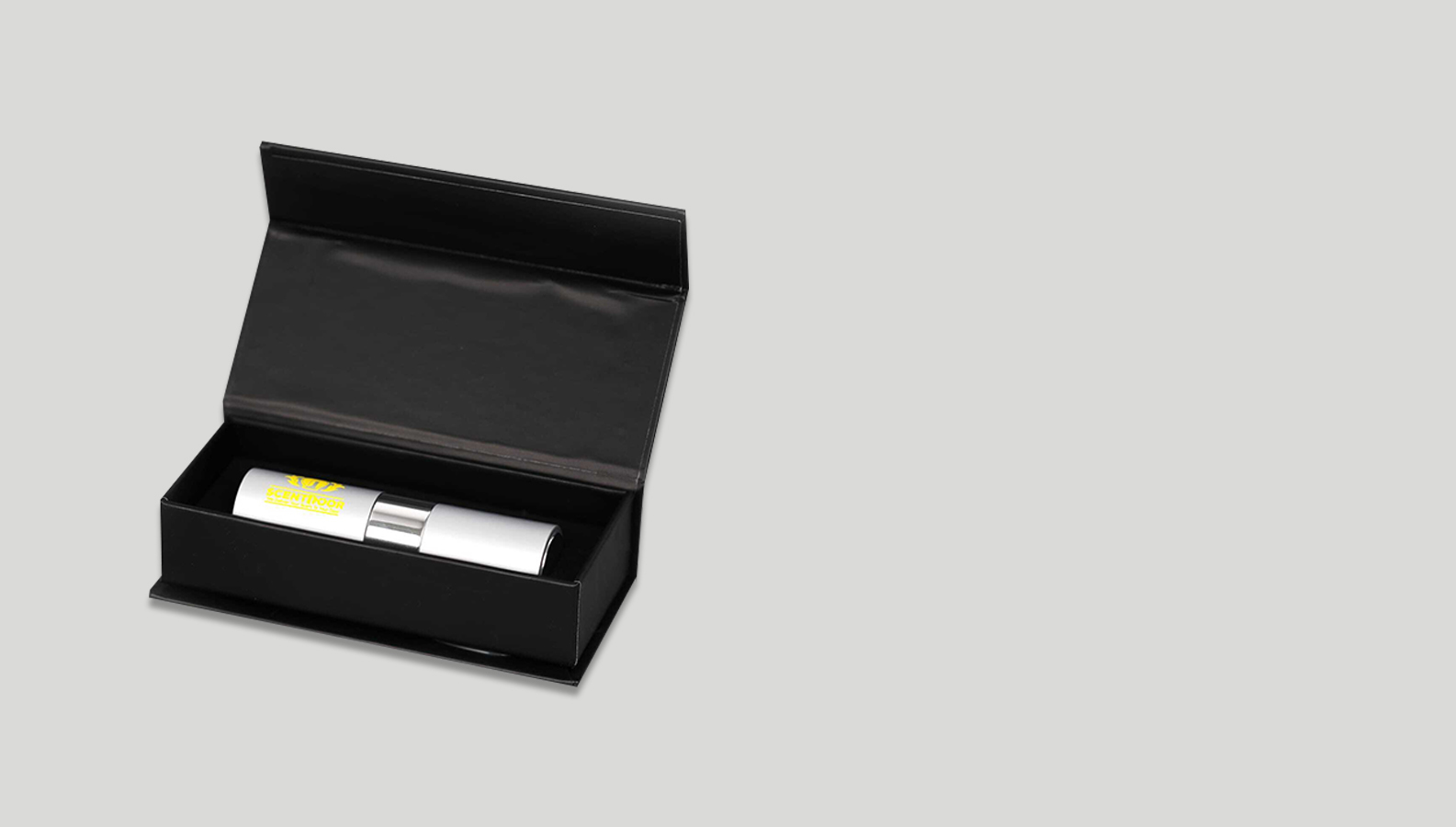
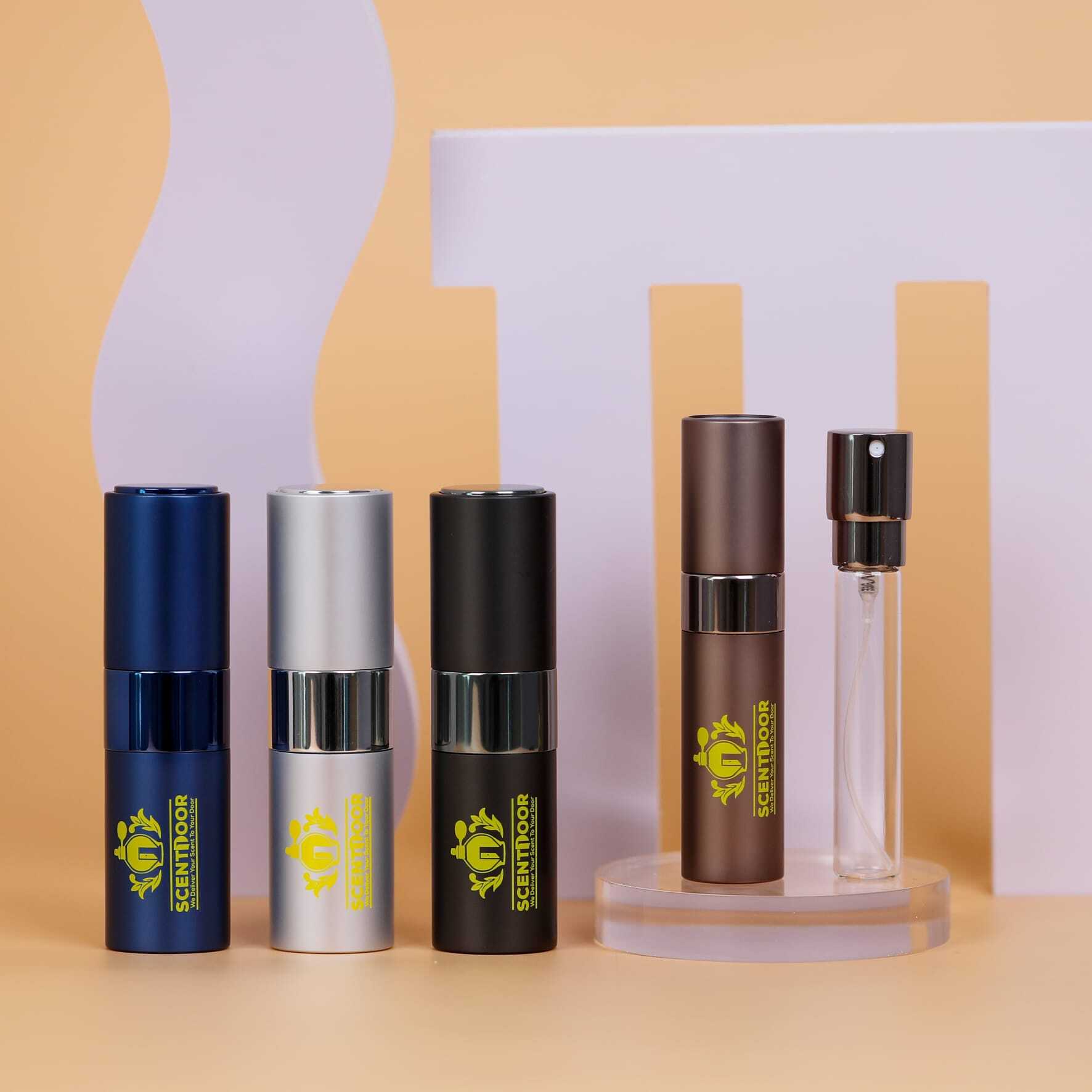
A decant is genuine fragrance transferred out of its full-size bottle and into a compact atomizer. For travel, the sizes do most of the work. Scent Door fills five sizes, and the Our Bottles page gives the ounce figure for each:
- 5 ml — about 0.16 oz
- 8 ml — about 0.27 oz
- 10 ml — about 0.33 oz
- 15 ml — about 0.50 oz
- 20 ml — about 0.67 oz
Even the largest of those is about a fifth of the 3.4 oz limit. There is no squinting at the bottom of the bottle, no rounding question and nothing for an officer to debate. Several small atomizers also take up far less room in a quart bag than one 100 ml flacon, which leaves space for the toiletries you actually need.
The format helps too. Scent Door’s main bottle is a small aluminum twist-up atomizer built for travel, and product listings offer a twisted-up aluminum glass bottle in all five sizes, plus a plastic bottle in 5 ml, 10 ml and 20 ml. The aluminum shell surrounds a glass inner vial, so the glass is not the outer surface taking the knocks. If you are deciding between the two, our page on aluminum vs plastic decant bottle options goes through the trade-offs, and the perfume sizes chart shows how each size compares with full bottles.
Bring options, not one big bottle
Travel is also when a single signature scent feels repetitive. A few small decants let you carry a fresh scent for the daytime, something warmer for dinner and a spare in case one does not suit the weather where you land. That is a wardrobe in the space of one tube of sunscreen. If you are new to buying in this format, our guide on how to buy decants explains what to look for.
One note on fill level. An atomizer needs air at the top to build pressure, and Scent Door states that it uses measuring devices so each bottle holds the amount listed. That headspace is there by design, not a short pour.
The best travel bottle is the one nobody at security needs to think about twice.
How do you stop perfume leaking on a flight?
Leaks on planes usually come from three things: pressure, pressure on the sprayer and position. Cabins are pressurized, but not to sea level, so air trapped in a bottle tries to expand as the plane climbs. A tight seal resists that well. A loose cap, a sprayer that gets pressed by a laptop, or a bottle lying on its side in a crowded bag gives the liquid a way out.
- Close it fully before you pack — twist an atomizer down so the sprayer sits inside its shell, and make sure any cap is firmly in place.
- Travel upright — stand bottles in a corner of your toiletry bag or in a pouch that keeps them vertical.
- Double-bag — the quart bag already acts as a second layer in your carry-on; in checked luggage, use a zip-top bag of your own.
- Keep it away from pressure points — do not wedge a sprayer under a laptop, a hardcover book or a pair of shoes.
- Test the first spray — after a day in transit, point the nozzle away from your face for the first press in case it sputters.
Heat matters as well. A bottle left in a sunny car on the way to the airport, or in a jacket pocket against a radiator in the terminal, starts the trip under more pressure than it should. Cool and shaded is the goal from door to door.
What a small leak does to a suitcase
Fragrance oils stain silk and pale fabrics, and the scent can cling to a suitcase lining for weeks. A zip-top bag costs almost nothing compared with dry cleaning an outfit or living with a smell you did not choose.
Is duty-free perfume allowed on connecting flights?
Sometimes, with conditions. TSA allows duty-free liquids larger than 3.4 oz in a carry-on when you are traveling to the United States on an international flight and have a connecting flight afterward. The rules on the TSA liquids page are specific:
- Sealed bag — the retailer must pack the item in a transparent, secure, tamper-evident bag.
- Receipt — the original receipt must be with the item.
- Timing — the purchase must have been made within 48 hours.
- Screening — the contents still have to be screened, and anything that alarms or cannot be screened will not be allowed in your carry-on.
TSA’s own advice is to pack liquids over 3.4 oz in checked baggage when you can, even if they are in a tamper-evident bag. If you know you will connect after an international arrival, the safest plan is to move a large duty-free bottle into your checked suitcase once you collect it at customs, before you go through security again.
Can you bring perfume on a plane on international flights?
Usually, yes, but the rules belong to the country you are departing from, not to the TSA. Many airports around the world use a similar 100 ml limit for liquids in hand luggage, yet bag sizes, screening technology and the details of each rule differ by country and sometimes by airport. Before an international trip, check the departure airport’s own security guidance, and check again for the return leg and any connection along the way.
Airline rules can add another layer, especially on smaller carriers. Small decants avoid most of the uncertainty: a 5 ml or 10 ml atomizer is well under every common limit, so the only real question left is whether your liquids bag closes.
Customs is a separate question
Security screening decides what can go in the cabin. Customs decides what you may bring into a country and whether duty applies. Personal allowances differ from one country to the next, so a suitcase full of full-size bottles bought abroad is something to look up before you shop.
Is it okay to spray perfume during a flight?
It is allowed, but it is rarely a good idea. An aircraft cabin is a small shared space, the air is recirculated, and the passenger beside you cannot step away. Some people get headaches from strong scents, and a few have real sensitivities to fragrance ingredients. A single generous spray can drift well beyond your own row.
A better routine:
- Apply before you leave home — one or two sprays on skin, given time to settle before you reach the airport.
- Go lighter than usual — what reads as subtle in an open room can feel loud in a cabin.
- Refresh after landing — the restroom at arrivals is a far better place for a top-up than seat 23C.
- Use the lavatory if you must — on a long-haul flight, a quick touch to the wrists in private beats spraying at your seat.
Which fragrances work best for travel days?
Travel days reward scents that stay close to the skin and smell clean rather than sweet or smoky. Fresh citrus openings, soft woods, light musks and gentle aromatics tend to sit politely in a cabin, while dense gourmands, heavy ouds and loud amber blends are better saved for the evening you arrive.
One example from the shop is Gypsy Water by Byredo. Its listing gives notes of bergamot, lemon, pepper, juniper berries, incense, pine needles, orris, amber, vanilla and sandalwood: a crisp, outdoorsy opening that settles into a soft woody base. Worn lightly, that kind of profile suits an airport morning far better than something built to fill a room.
Think about the destination too. A humid beach trip and a dry, cold city break call for different scents. If you are heading somewhere warm and sticky, our Florida travel tips cover which fragrance styles hold up in heat and humidity.
A pre-flight perfume packing checklist
Run through this list the night before you fly and the fragrance side of the trip is done.
- Read the bottle size — check the capacity printed on each bottle, not the amount left inside.
- Carry-on: 3.4 oz (100 ml) or less — anything larger goes in your checked suitcase.
- One quart bag — confirm every liquid, including fragrance, fits and the bag closes.
- Checked bag: watch the total — keep toiletry articles within the FAA’s 2 kg (70 oz) or 2 L (68 fl oz) per-person cap, with no single bottle over 500 ml (17 fl oz).
- Close and cap everything — twist atomizers shut and fit caps over sprayers.
- Bag it and pad it — zip-top bag, then soft clothing around it, in the middle of the case.
- Keep bottles upright — stand them in a pouch or shoe so liquid is not resting on the sprayer.
- Avoid heat on the way — no bottles left in a hot car or on a sunny dashboard.
- Duty-free on a connection — sealed tamper-evident bag, receipt, bought within 48 hours, or move it to checked luggage.
- International leg — check the departure airport’s own liquids rules for every flight.
- Apply before boarding — skip spraying in the cabin and refresh after landing.
If your current fragrances only come in large bottles, a few small atomizers solve the problem for good. You can shop travel-size decants in 5 ml to 20 ml sizes and keep them packed in your toiletry bag between trips.
More from Scent Door
- perfume sizes chart
- Our Bottles
- aluminum vs plastic decant bottle
- how to buy decants
- perfume storage
- Florida travel tips
Frequently asked questions
Is perfume allowed in checked luggage?
Yes. Checked bags can carry perfume bottles larger than 3.4 oz (100 ml), up to 500 ml (17 fl oz) each. All your toiletry articles together must stay within 2 kg or 2 L per traveler under FAA rules. Keep caps on and seal every bottle in a zip-top bag before packing.
Does a 100ml perfume bottle count as 3.4 ounces?
Yes. TSA treats 100 milliliters and 3.4 ounces as the same carry-on limit, so a bottle labeled 100 ml is allowed in your carry-on as long as it fits in your quart-size liquids bag. A bottle labeled any larger, even slightly, needs to travel in checked luggage instead.
Can I bring a half-used large bottle in my carry-on?
No. Screening goes by the capacity printed on the bottle, not by how much perfume is left in it. Any bottle made to hold more than 3.4 oz (100 ml) has to travel in checked baggage, however light it feels. A small decant is the cabin-friendly way to bring that fragrance along.
Does perfume count toward my quart-size liquids bag?
Yes. Perfume is a liquid at the security checkpoint, so every bottle you carry on, whatever its size, goes inside your single quart-size bag together with toiletries such as toothpaste and lotion. If the bag will not close with everything in it, something has to move to checked luggage.
How many decants fit in a TSA liquids bag?
There is no fixed number. The TSA rule limits each container to 3.4 oz (100 ml) and requires all of them to fit in one quart-size bag, so the answer depends on what else you pack. Slim 5 ml to 20 ml atomizers take up little space, leaving room for several beside your toiletries.
Can cabin pressure make a perfume bottle leak?
It can. The FAA notes that pressure and temperature changes in flight can cause containers to leak. Air in a bottle expands as the cabin pressure drops, pushing liquid toward any weak seal. Close atomizers fully, fit caps over sprayers, keep bottles upright, and pack them inside a sealed bag.
Is duty-free perfume allowed through security on a connection?
It can be, when you are flying to the United States and connecting onward. The bottle must be in a transparent, secure, tamper-evident bag packed by the retailer, with the original receipt, bought within 48 hours, and it must clear screening. TSA still recommends checking anything over 3.4 oz.
Do I have to take perfume out of my bag at the checkpoint?
Your perfume stays inside the quart-size liquids bag, but you may be asked to take that bag out of your carry-on. TSA says separating it from your carry-on helps screening. Procedures can differ by lane and by airport, so follow the instructions given at your checkpoint.
Is it rude to spray perfume on a plane?
Usually, yes. A cabin is a small shared space with recirculated air, and nearby passengers cannot move away from a strong scent. Some people get headaches or react to fragrance. Apply one or two light sprays before you leave home, and save any top-up for after you land.
What is the best way to wrap a glass perfume bottle for a suitcase?
Cap the bottle, seal it in a zip-top bag, then wrap it in a thick sock or a rolled sweater. Place it upright in the center of the suitcase with soft clothing on every side, away from the walls, wheels and corners, where bags take the hardest knocks during handling.

Leave a Reply